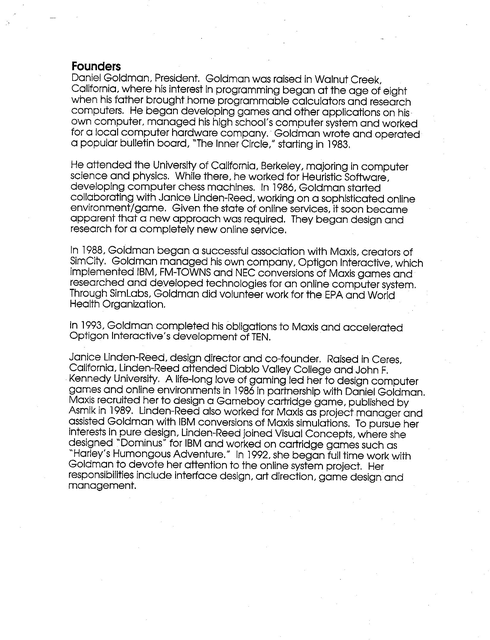
Daniel Goldman
Co-founder · President · product and technical leadership
Conceived TEN with Linden-Reed, led Optigon, built the technical and company foundations, and drove early game, capital, and distribution relationships.
Period documentation





02 / People
TEN was built by people who envisioned the service, assembled the team and technology, shaped its community and editorial product, made its licenses, and operated the company.
Co-founder · President · product and technical leadership
Conceived TEN with Linden-Reed, led Optigon, built the technical and company foundations, and drove early game, capital, and distribution relationships.
Period documentationCo-founder · Design Director
Central architect of the interface, visual system, game design, user experience, art direction, and product-management practice.
Period documentationProduct · games · community systems
Worked across UI and game design, community features, rankings, and tournament infrastructure through Optigon, TEN, and Pogo.
Career recordEarly team · technical contribution
The founders remember Pletner as one of the early technical contributors who helped make the service real.
FirsthandEarly team · technical contribution
The founders remember Antone among the early technical contributors who built TEN.
FirsthandFirst employee · community management
Built and represented the community. The work mattered because social operation and software were one product.
First-employee status: firsthandEditorial Director · community and distribution vision
Joined in July 1995 from Computer Gaming World. TEN’s own bio credits his community events and environments; the distribution vision is firsthand history.
TEN biographyBusiness development · licenses and partnerships
Held business-development roles at Planet Optigon and TEN during the licensing and commercial expansion of the network.
TEN management pageFinance · operations
Served as CFO and vice president of operations and finance during the company’s early scaling period.
Contemporary pressBrand · finance · operating counsel
Brought entertainment and operating experience from Colossal Pictures and TriStar; helped shape TEN’s brand, positioning, and company form.
Artifact + firsthandBrand · positioning · operating counsel
Buder’s consulting partner and a formative contributor to the service’s public identity and operating shape.
Artifact + firsthand03 / Capital & control
Period reports establish the investments and corporate changes. Goldman’s account supplies the private conversations behind them.
Founder-funded, then independently supported
Goldman initially funded TEN with the royalties he earned from SimCity. The first outside angel check came from Kern, a friend of Alan Buder. Kern independently recalled TEN as his first Internet investment. He came from Westinghouse/Group W and had run KPIX Channel 5 in San Francisco.
Art Kern oral history ↗Private sequence: firsthand
Ruthann Quindlen evaluated TEN and, according to the founding-team account, declined because Vinod Khosla was not interested. The account says she then backed Mpath with the person who had performed TEN’s diligence.
The public record confirms Quindlen’s Mpath board role beginning in January 1995. It does not establish the quoted reason, the diligence transfer, or the private discussion.
Public financing + firsthand encounter
The account says Khosla approached Goldman at a conference within months, told him TEN was the company he had been looking for, and invested. Period reporting independently places TEN’s first venture round from Kleiner Perkins in June 1995.
San Francisco Chronicle report ↗What followed
In 1995 Planet Optigon acquired Outland with Kleiner Perkins funding, according to the founding-team account and a later TEN management biography; public announcements framed the deal as a merger. Optigon became T E Network, Inc. The Outland group brought important Internet gaming and networking expertise. It did not invent the already operating TEN concept.
Goldman says Khosla pushed the service away from editorial and distribution toward hardcore games. TEN’s 1994 and 1995 materials describe broad community and editorial ambitions. Action games dominated its public identity by 1996, although editorial, developer, CD-ROM, and download functions continued into 1997.