The Inner Circle
Daniel Goldman wrote and operated a BBS that fostered community online, with a simple friend graph, hackers, and everything you would expect in the 1980s.
Founding account F01





01 / Origins
Before Kleiner Perkins and acquisitions, there was a dream of online community and games made real by a dedicated team, funded by game royalties, in a small office in Emeryville, California.
Daniel Goldman wrote and operated a BBS that fostered community online, with a simple friend graph, hackers, and everything you would expect in the 1980s.
Founding account F01Goldman and Linden-Reed start collaborating on a mythology and folklore-based MMO dubbed “Epic.” It needs the technology and framing to support it. That becomes Optigon Interactive and Total Entertainment Network.
Founding account F02Optigon publicly presented TEN and distributed the beta over Sprint’s national X.25 dial-up network.
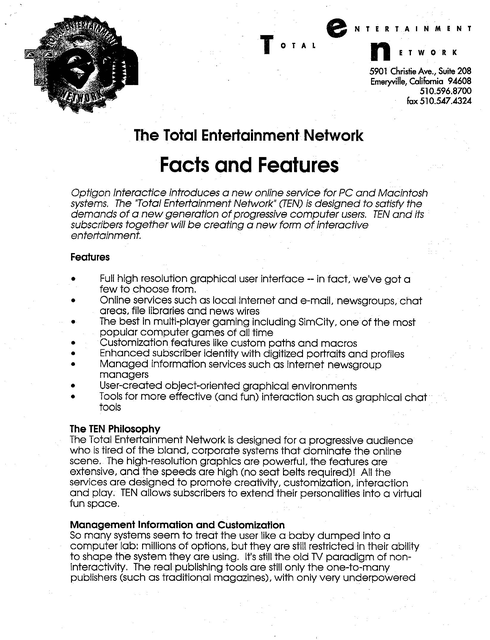
1994 press and product record“TEN is designed for a progressive audience… The services are designed to promote creativity, customization, interaction and play.”
Optigon, Facts and Features, 1994The 1994 product definition is explicit: a graphical interface; email and newsgroups; chat, files, and news wires; portraits and profiles; paths and macros; multiplayer games; information tools; and user-created graphical environments. SimCity, WizWar, chess, backgammon, and Go were activities inside the community, not the limit of it.
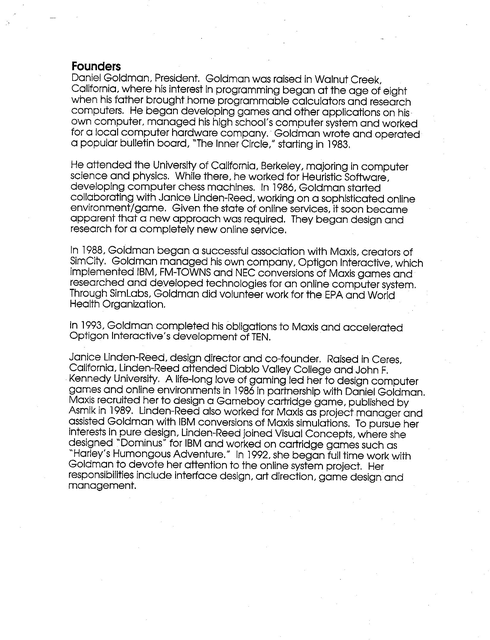
The founders were Daniel Goldman, president and technical/product leader, and Janice Linden-Reed, design director responsible for interface design, art direction, game design, and management. A period profile says their collaboration began in 1986 and that Linden-Reed moved full-time onto the service in 1992. Profile
The system drew on Optigon’s work with Maxis from 1988 through 1993, then moved from proprietary dial-up infrastructure toward the commercial Internet without abandoning its community thesis. The service called TEN was already public before Outland entered the story. Its early game progression ran from multiplayer SimCity in 1994 to WizWar, Descent, and most two-player games in 1995, then to the much more demanding Quake integration in 1996.
The original ambition
The 1995 shift
The return to community